Liquid Cooling Changes More Than the Rack
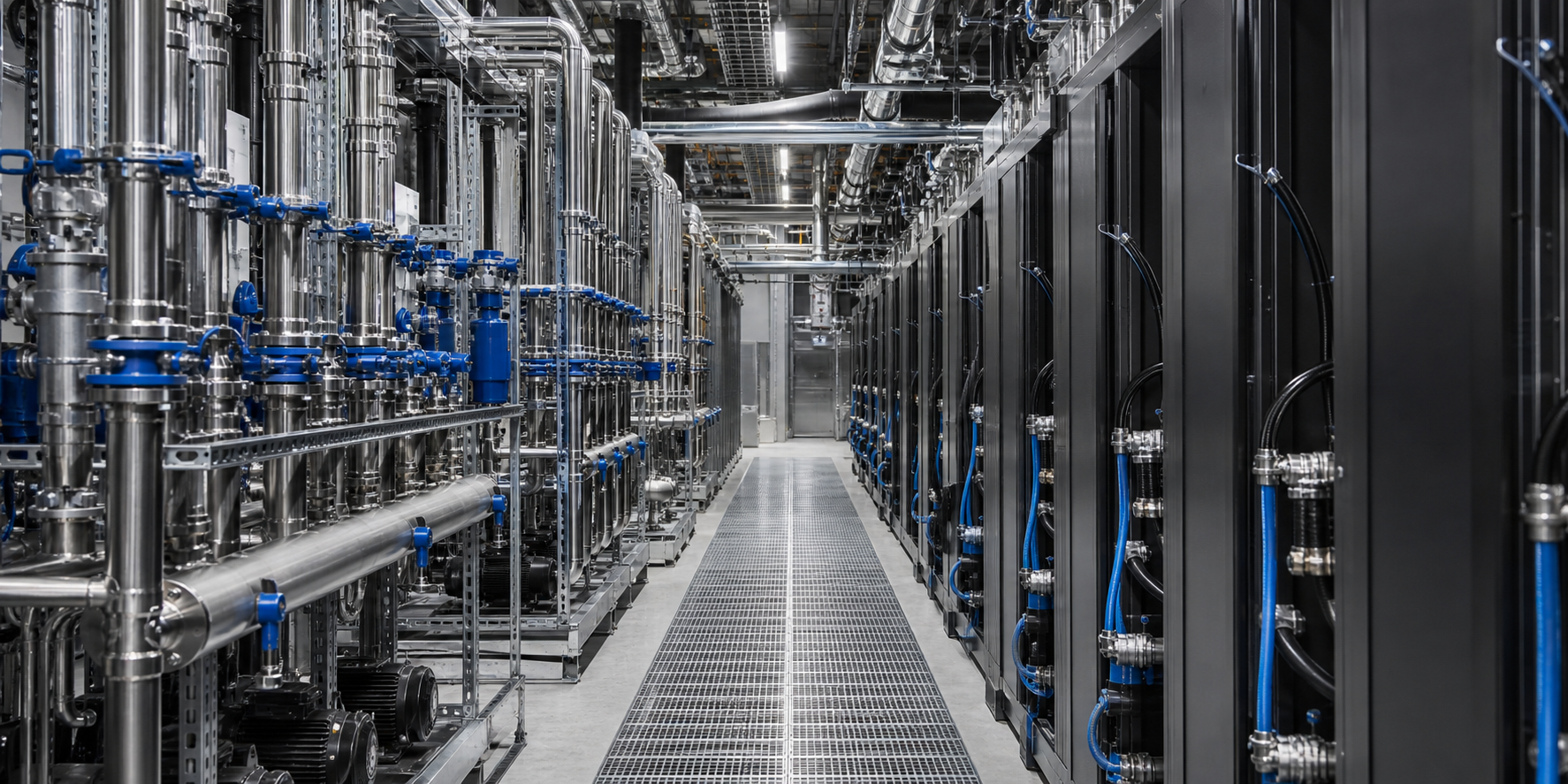
Liquid cooling is often described as a rack-level technology. In practice, it changes decisions across the entire facility. Once heat moves into a fluid loop, mechanical, electrical, structural, controls, and operating requirements all need to be coordinated around it.
Density Moves the Design Boundary
High-density accelerators concentrate more heat in less space than conventional air-cooled environments were designed to handle. Direct-to-chip loops and rear-door heat exchangers can remove that heat efficiently, but they introduce cooling distribution units, pumps, manifolds, valves, filtration, and water-quality requirements.
Power and Cooling Are One Capacity Plan
More rack density increases electrical demand while changing the cooling load profile. The power train and cooling plant should be modeled together so that a nominal rack count does not exceed the real capacity of either system. Redundancy also has to be evaluated under the same failure scenarios.
Interfaces Decide Reliability
The most important details are often at the boundaries: facility water to technology loop, fixed piping to flexible connections, and controls to hardware requirements. Clear ownership of pressure, temperature, flow, water quality, leak detection, and isolation prevents gaps between vendors.
Operations Need to Be Designed In
Teams need safe access to components, practical isolation zones, drain and fill procedures, spare parts, and clear alarm responses. Commissioning should prove both normal performance and failure behavior before valuable compute is connected.
The Bottom Line
Liquid cooling enables the density modern AI demands, but it is not an accessory. Treating it as a facility-wide system from the beginning produces a more reliable deployment and a clearer path to future hardware generations.